











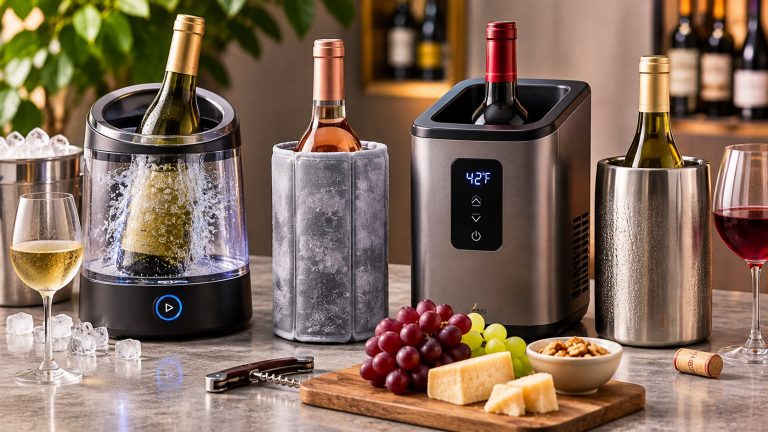
Most wine gets poured at the wrong temperature. Whites come out of the fridge too cold to taste like anything, and reds sit at room temperature in a kitchen that’s warmer than any cellar ever was. A chiller isn’t about luxury; it’s about getting the bottle into the range where the wine shows what it’s got.
The trouble is that “wine chiller” covers at least four different devices that work in completely different ways. Before you decide which one belongs in your kitchen, it helps to know what each is built to do.
The three ways a bottle gets cold
A rotating spray chiller sits on the counter, takes ice and water, and spins the bottle while it sprays it. That motion is why it’s fast: roughly six minutes for wine, about three for a can. It’s also why it’s loud.
Gel sleeves are the opposite. You freeze a flexible insulated sleeve, which takes around six hours, then slide it over the bottle. No power, no noise, no ice, and it folds flat in the freezer between uses.
Electric thermoelectric coolers are the newest of the group. They hold a chamber at a set temperature, usually somewhere in the 2 to 20°C range, without ice at all. They’re slower from room temperature (15 to 45 minutes) but they’re silent and they hold.
Then there’s the double-walled vacuum sleeve you drop a cold bottle into, which chills nothing but keeps a bottle cold for about four hours on a patio table. Useful, but it’s a holder, not a chiller.
A rapid wine chiller earns its counter space on short notice
The case for the fast, active machines comes down to one scenario: a guest arrives, mentions they’d rather have white, and the only white in the house is sitting in the pantry at 70°F. Nothing else in a home kitchen closes that gap in six minutes.
That speed has a price in inputs. Each bottle burns through about two cups of ice, which is fine with an automatic ice maker and tedious without one. Starting from a bottle sitting at full room temperature, expect ten to twelve minutes rather than six.
A side-by-side comparison of rapid wine chillers on Basil Carmel lays the trade-off out plainly: the fastest machines are the loudest and the fussiest about bottle shape, while the silent ones ask you to plan thirty minutes ahead.
One more thing about rotation: it chills and then stops. Pull the bottle out and it starts warming on the table like any other bottle. If dinner runs three hours, that single six-minute sprint is the beginning of a cycle, not the end of it.
Measure your bottles before you buy anything
This is the detail people skip, and it’s the one that ends with a returned box. Diameter limits are real and they vary a lot by type.
- Electric chambers tend to accept bottles up to roughly 3.66 inches across, the most generous of the group.
- Gel sleeves generally fit standard 750ml bottles under 3 inches.
- Rotating chillers are usually the strictest, though removable lids help with taller bottles.
- Champagne and prosecco, with their wide punt-heavy bases, get rejected by most chillers outright.
Plenty of modern wines ship in heavy, wide-bottomed glass that looks nothing like a classic Burgundy bottle. Take a tape measure to whatever you buy most often. If sparkling wine is a regular thing in your house, assume an ice bucket stays in the rotation unless you’ve confirmed the chamber width.
Holding temperature is a separate job from reaching it
Once you know how fast each type chills, ask how long it keeps the bottle there. That’s where the choice usually settles.
Gel sleeves hold for three to four hours after a proper freeze, which covers most dinners. Electric coolers will sit at a set point for up to 24 hours, so you can park a red at 55°F and a white at 42°F and stop thinking about it. Rotation holds nothing.
For a single pour before a quiet evening, speed wins. For a long table with people lingering, the hold matters more than the sprint, and you avoid the guess-and-rechill routine where the bottle bounces between the fridge and the table all night.
Small habits that make any chiller work better
The biggest time-saver costs nothing: give the bottle thirty minutes in the fridge first, then let the chiller handle the final stretch. You use less ice, less power, and less patience.
Where you put the unit matters too. Keep it out of direct sunlight, away from the oven and the dishwasher vent, and out of a draft. Temperature swings are hard on wine, and they make any chiller work harder than it needs to.
A few things worth doing once you’ve settled on a type:
- Put a small thermometer inside a storage-style cooler so you’re reading the chamber, not trusting the display.
- Check humidity if you’re holding bottles for weeks; corks prefer something in the 50 to 80 percent range.
- Wipe down a gel sleeve’s vinyl exterior and refreeze it flat, so it’s ready the next time.
- Remember that cooling units are for unopened bottles; once a cork is pulled, finish it within a few days or use a preservation stopper.
And keep the apartment-sized question in view. A rotating machine in a small kitchen is a loud appliance you hear from the sofa, while a silent thermoelectric unit sits on the dining table all evening and nobody notices it. If most of your entertaining happens on a deck or at a campsite, a 12V model that runs off a car outlet changes what’s possible outdoors.
That guest who wanted white instead of red is still the best test. If that happens twice a year, a gel sleeve kept in the freezer handles it without any fuss. If it happens every other weekend, you want something that doesn’t need six hours of warning.